How to Get a VPN When You're Already in China (2026 Guide)
You open the App Store, type "VPN", and none of the results are what you're looking for. Google Play won't load at all. The VPN websites you remember from home don't open either.
Every guide you find says the same thing: "install a VPN before you travel to China." That advice is useless now. You're here, you have a job or a semester ahead of you, and you need a working connection this week, not on your next trip home.
The good news: you can still get a VPN in China. This guide covers the working methods in 2026, matched to your device. iPhone users will set up a US Apple ID (no credit card needed). Android users have it easier: at the time of writing, this website loads normally in mainland China, and you can download the official SealVPN APK directly from it.
Pick your path from the table below and follow the steps.
Why VPN Apps Are Missing From App Stores in China
VPN apps are not available on the China App Store. If your Apple Account is set to the China region, searching for any well-known VPN returns nothing. This isn't a glitch, and reinstalling the App Store won't change it.
On Android, Google Play isn't available on mainland networks, and most phones sold in China ship without it. Local app stores don't carry VPN apps either.
Most VPN providers' websites are also unreachable from local networks. That's why the standard advice is to install everything before arrival. The advice isn't wrong, it's just too late for you, and it explains why so many guides have nothing useful to say once you've landed.
There's one more piece of context worth knowing. Whether an app appears in your App Store depends on your Apple Account's region, not your physical location. The store itself works fine from China.
That single fact is the key to Method 1. You don't need to change networks to fix the problem; you need to change which region's store you're looking at.
And if you're reading this from China, you already have the other half of the solution: a page that loads and hosts the official downloads.
Which Method Fits Your Situation?
| Your situation | Best path | Time needed |
|---|---|---|
| iPhone, China-region Apple Account | Method 1: US Apple ID | About 15 minutes |
| Android phone | Method 2: official APK from this site | About 3 minutes |
| Phone from home with roaming or a travel eSIM | Method 3: use it as a bridge for Method 1 or 2 | Immediate |
| Mac or laptop | Same account as Method 1, via the Mac App Store | About 5 minutes extra |
If you're not sure, start with your phone. It's the device you'll use the VPN on most.
Method 1: iPhone, Download a VPN in China With a US Apple ID
The US App Store carries the VPN apps that the China store doesn't. To use it, you need an Apple Account registered in the US region.
Quick check before you do any work: if your Apple Account is still registered in your home country, open the App Store and search for SealVPN right now. Many regional stores carry it, and if yours does, you can skip this whole section and just install it. The steps below are for you if your account is China-region, or if your home region's store doesn't list the VPN apps you need. That second case is more common than you'd expect.
One important decision first: don't convert your existing Apple Account to the US region. Apple requires you to cancel subscriptions, spend your remaining balance, and provide a payment method valid in the new region before changing your account's country. It's slow, and it breaks your Chinese apps.
Creating a second, separate US account is faster and keeps your current account untouched. Here's how.
Step 1: Create a US Apple ID Without a Credit Card
You need three things, and none of them is a credit card:
- A new email address that has never been linked to an Apple Account
- Your existing phone number. A +86 number works fine for verification
- A US address from a tax-free state like Oregon, copied from any real business on a map
During setup, set the payment method to None. That option exists for every new US account, and choosing it is what makes the credit card unnecessary. The whole process takes about 5 minutes. Follow the full walkthrough in our guide to creating a US Apple ID without a credit card, including address templates and fixes for common errors.
One practical tip from that guide is worth repeating here: create the account in a browser at Apple's website rather than on the phone. It keeps the new account cleanly separated from your device until you're ready for the next step, and it makes the region selection explicit instead of inherited from the phone's settings.
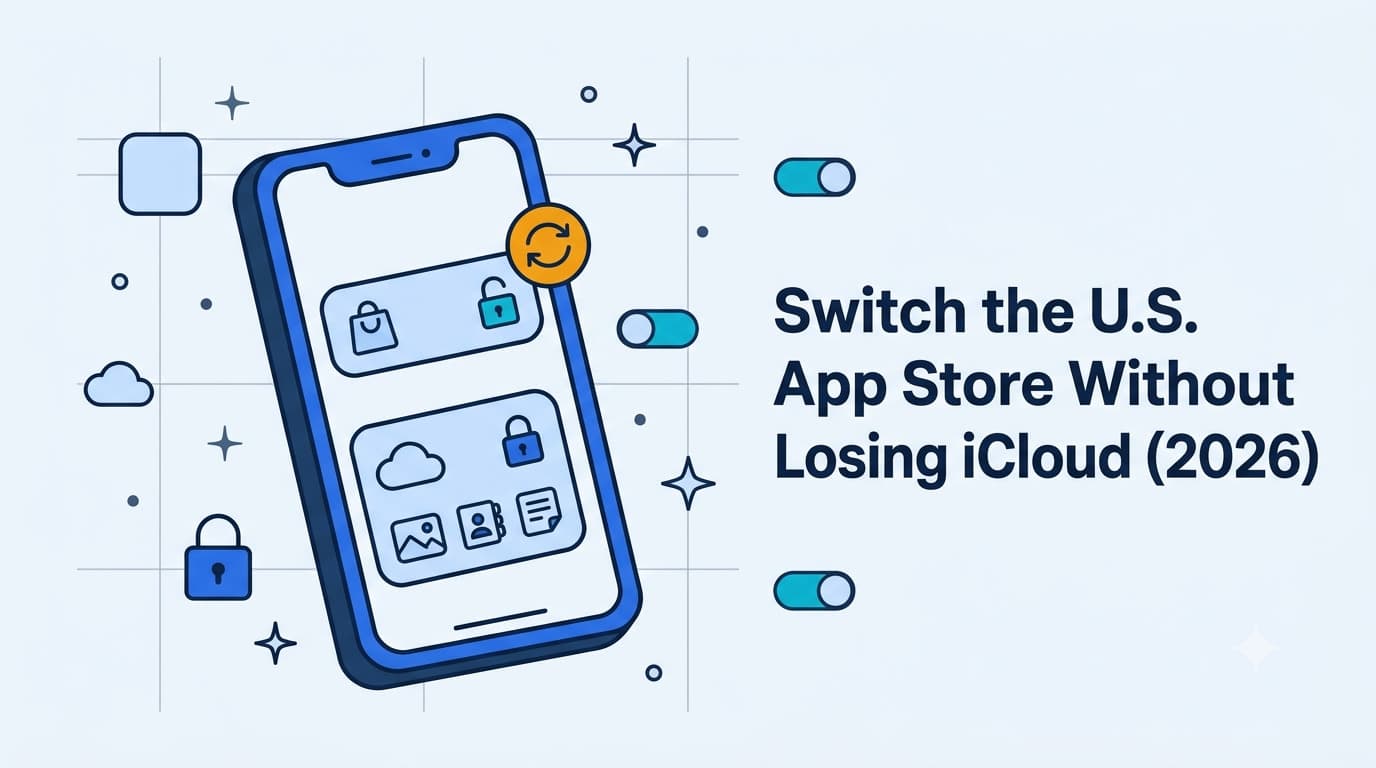
Step 2: Sign In to the App Store Only, Never in Settings
This is the step where people damage their data, so read it before tapping anything.
Do not sign in with the US account at the top of the Settings app. That signs your whole phone into a new iCloud account. Photos, contacts, and notes can disappear from the device.
The safe way is to sign in only inside the App Store:
- Open the App Store and tap your profile picture
- Scroll down. If you see Sign Out, tap it
- On iOS 26.4 and later, that button may be gone. Go to Settings → your name → Media & Purchases and sign out there instead
- Back in the App Store, sign in with your US Apple ID
The Settings screen in step 3 also has a red Sign Out button at the very bottom. That one signs out your entire iCloud account. You want Media & Purchases in the middle of the screen, not the red button. Our guide to switching App Store regions without losing iCloud data covers both paths with screenshots.
Once you're in the US store, search for SealVPN and install it, or use this direct link: download SealVPN for iPhone. Open the app, create an account, and connect with one tap.
The Same Account Works on Your Mac
Sign in to the Mac App Store with the same US Apple ID and you can install SealVPN for Mac the same way. If you mostly need coverage inside a browser, there's also a SealVPN Chrome extension, though reaching the Chrome Web Store from a local network usually requires the VPN to be working first. Set up your phone before your laptop.
What Happens to App Updates Later?
Apps remember which account installed them. When SealVPN needs an update, your phone will ask for the US account's password. Sign in through Media & Purchases, update, and switch back if you like.
Your iCloud, iMessage, and Chinese apps are never touched by any of this. The two accounts live side by side. Keep the US account's email and password somewhere safe; you'll need them a few times a year.
Method 2: Android, Download the Official SealVPN APK
Android skips the account work entirely. You install the app directly from the APK file, no app store involved.
- On your phone's browser, open the SealVPN download page
- Download the Android APK
- When prompted, allow your browser to install unknown apps. This is a standard Android permission screen, shown once
- Open the downloaded file and tap Install
- Launch SealVPN and connect with one tap
The whole process takes about 3 minutes on a normal connection.
Two things your phone may show you along the way, both normal. First, the browser might warn that "this type of file can harm your device" before downloading; that's Android's standard message for every APK, not a judgment about this one.
Second, phones with Google Play Protect may offer to scan the app before installing. Let it scan. An official APK passes.
If your phone is a Chinese brand without Google services, the flow is the same. The install permission screen may be labeled differently depending on the manufacturer's Android skin, but it's always a one-time approval tied to the browser you downloaded with.
Only install VPN APKs from the provider's official website. Third-party APK sites repackage popular apps, and VPN apps are a favorite target because they handle all your traffic. A research analysis of 283 Android VPN apps found that 38% showed signs of malware. A VPN from an unofficial source can be worse than no VPN at all.
Method 3: No Working Route? Use Roaming Data as a Bridge
Websites' reachability from mainland networks can change. If you ever can't open the download page, or you're setting up from a network that behaves differently, there's a reliable fallback: foreign mobile data.
When your home-country SIM is on international roaming, its traffic routes through your home carrier. The same is true for travel eSIMs bought before or during your trip. On that connection, app stores and VPN websites load as they would at home.
Use the roaming connection just long enough to finish Method 1 or Method 2, then switch back to your local SIM or WiFi. A few megabytes is enough for the account setup; the app download itself is small. If roaming data is expensive on your plan, turn it on, do the setup, and turn it off again. The total cost is a single coffee, not a phone bill.
A note on travel eSIMs: buying one requires a working internet connection, so it's a tool to set up while you still have one, not a rescue for a phone that's completely offline. If a friend or colleague already has a VPN working, their hotspot serves the same bridging purpose for the ten minutes you need.
If you arrived with a roaming-capable SIM and haven't removed it yet, keep it. Even with no credit on it, many carriers let you re-enable roaming data from their app or website. It's your permanent backup channel for exactly this kind of task.
Keeping Your VPN Working for a Semester or a Work Contract
Getting the app installed is day one. If you're in China for a year of work or study, plan for the months after.
Picture the moment this section is written for: it's November, you're three months into the semester or the contract, and your phone offers a SealVPN update. It asks for a password you set once in August and haven't typed since. The people who breeze through that moment did three small things early.
Keep the US Apple ID alive. You'll need it for every app update on iPhone. Store the email and password in a password manager the same day you create them. If you want paid apps or an in-app subscription on that account later, top it up with a gift card; here's how to recharge a US Apple ID with gift cards. No gift card is needed for free apps and updates.
Keep a second install path ready. Don't delete the APK file on Android, and don't forget which account installed the app on iPhone. If you replace or reset your phone mid-semester, you'll repeat a 15-minute install, not the whole research project that led you to this page.
Expect the network to vary. Connection quality in restricted networks changes over time, on every VPN, and some weeks are noticeably worse than others. SealVPN is built for these environments and switches servers quickly, so trying a different server usually resolves a slow evening. What matters is that you don't interpret one bad night as a broken setup and start over from scratch.
Students: your university VPN is not the same thing. Some universities provide their own VPN for accessing library databases and campus systems from off-campus. It covers those systems and usually nothing else, and it often routes only university traffic. A personal VPN handles everything outside your university's network: your email from home, your messaging apps, your video calls. The two can be installed side by side without conflict, and switching between them takes seconds.
Working remotely for an employer back home? The same logic applies to corporate VPNs. Your company's VPN reaches company systems. For the ordinary tools around your job, calendar invites, documentation sites, and team chat, you'll still want your personal connection working underneath.
Frequently Asked Questions
Can you download a VPN from the China App Store?
No. VPN apps aren't listed on the China App Store, so no amount of searching will surface them. You need access to another region's store, which is what the US Apple ID in Method 1 provides.
Do I need a US phone number or credit card for the US Apple ID?
Neither. A +86 phone number passes verification, and the payment method can be set to None during signup. The details are in our guide on whether Apple ID needs a US phone number.
Will signing in to the US App Store delete my iCloud data?
Not if you sign in only inside the App Store, or through Media & Purchases. Data loss happens when people sign in to the new account at the top of Settings, which switches the whole device's iCloud. Follow Step 2 above and your photos and contacts stay exactly where they are.
Does the same US Apple ID work on an iPad or a second iPhone?
Yes. An Apple Account isn't tied to one device. Sign in to the App Store on the other device the same way, through the App Store profile or Media & Purchases, and install from your purchase history. The same warning applies everywhere: never at the top of Settings.
Does SealVPN have a free plan?
Yes. The free plan gives you basic VPN access with a limited set of server locations, which is enough to verify that everything works on your network before you pay anything. Premium unlocks the full server list, faster routing, and priority support. Starting on the free plan is a reasonable way to test your setup.
What if this website stops loading one day?
Reachability can change, which is why Method 3 exists. With roaming data or a travel eSIM as a bridge, you can always reach the download page or the US App Store. If the app is already installed, it keeps working; the website is only needed for downloads and account management.
Get Connected Today
Here's the short version of everything above:
- iPhone: create a US Apple ID (no credit card), sign in to the App Store only, and install SealVPN from the US store
- Android: download the official APK from this site and install it in about 3 minutes
- Backup: roaming data from your home SIM reaches everything, any time
- Long term: keep the US account's credentials and the APK file for updates and reinstalls
A week from now, this problem will feel small. Your apps from home will work, your group chats will load, and video calls with family won't need a workaround.
Ready to start? Download SealVPN for your device, or create a SealVPN account first and sign in after installing. One tap, and you're connected.
Published in August 2026. App Store behavior described here matches iOS 26.5 at the time of writing. If Apple changes the interface, check the linked guides for updated paths.
References: